It’s also one that some seismologists were anticipating.
Wednesday’s quake, in Russia’s Far East, occurred on a fault line running along the Kuril-Kamchatka Trench – a scar on the seabed caused by the Pacific tectonic plate diving beneath the North American and Okhotsk plates.
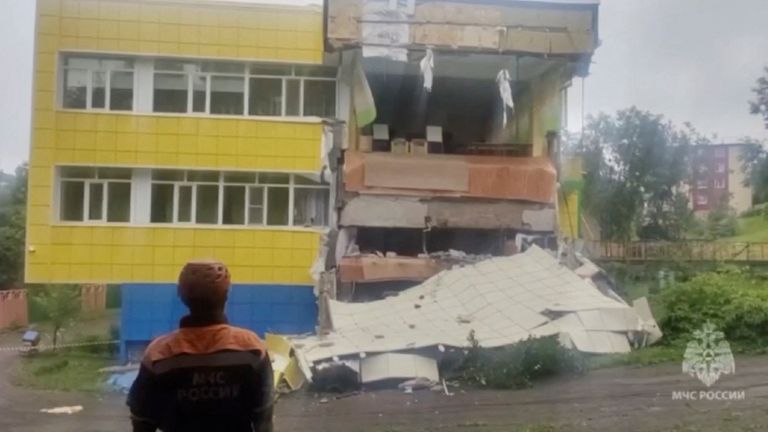
Image: A kindergarten is damaged by an earthquake in Petropavlovsk-Kamchatsky, Russia. Pic: Russian Ministry for Emergencies/Reuters
Called a subduction zone, it’s one of a series around the Pacific’s notorious “Ring of Fire”. The friction from shifting plates fuels volcanoes but is also notorious for causing “megathrust” earthquakes and resulting tsunamis.
The last major earthquake on the Kamchatka peninsula was in 1952, just 30km (18 miles) from this latest quake’s epicentre.
The US Geological Survey estimates that six metres-worth of tectonic movement had built up along the Kuril-Kamchatka Trench since then.
A series of “foreshocks,” including a 7.4 magnitude earthquake on 20 July, suggested those seven decades of stress were being transferred along the fault, indicating a major quake near the 1952 epicentre may have been imminent.
But the moment an earthquake strikes is always impossible to predict, so too is the size or spread of a resulting tsunami.
A massive earthquake doesn’t always correspond to a massive tsunami.
Please use Chrome browser for a more accessible video player
A host of factors, including the amount of movement on the sea floor, the area over which the movement spreads, and the depth of the ocean above, all play a role.
From the limited information so far, even in areas close to the epicentre, the tsunami waves were sustained, but nowhere near as large as the one that struck Japan in 2011.
Follow the World
Listen to The World with Richard Engel and Yalda Hakim every Wednesday
The 9.1 magnitude earthquake that caused the Tohoku tsunami generated a wave nearly 40 metres high in places. The combined impacts of the earthquake and tsunami claimed nearly 20,000 lives.
According to the Kremlin, no fatalities have been reported in Russia so far.
Please use Chrome browser for a more accessible video player
1:05
First tsunami waves hit Russia and Japan
It’s a very sparsely populated area, meaning casualties will almost certainly be lower than in comparable-sized quakes in Japan and Indonesia.
It’s also possible that the foreshocks that preceded the Kamchatka quake may have helped save lives.
Following the 20 July earthquake in Kamchatka, local tsunami alerts warned people to head to higher ground.
When this latest quake struck, with more than 10 times more power than the last, people may have acted even before the warnings came.
Ozzy Osbourne has taken his final tour of Birmingham - with his family experiencing the love of thousands of fans who turned out to see the heavy metal star come home."We love you, Ozzy!" came the shouts from the crowd as his cortege stopped at Black Sabbath Bridge in the city, a site that has become a shrine to the performer since his death at 76 last week. His family […]











Post comments (0)