A hospital in southern Israel has been hit by an Iranian missile strike.
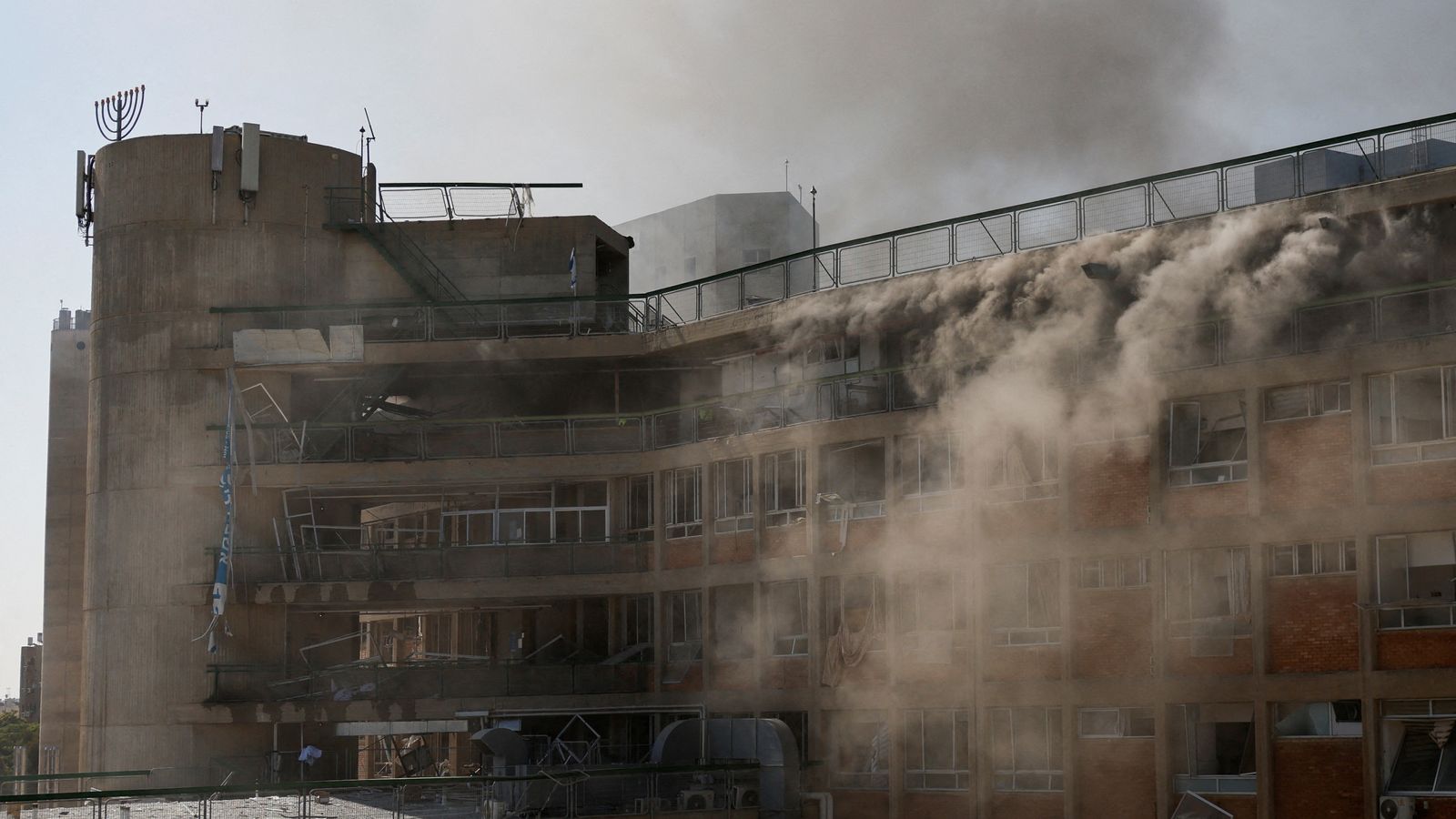
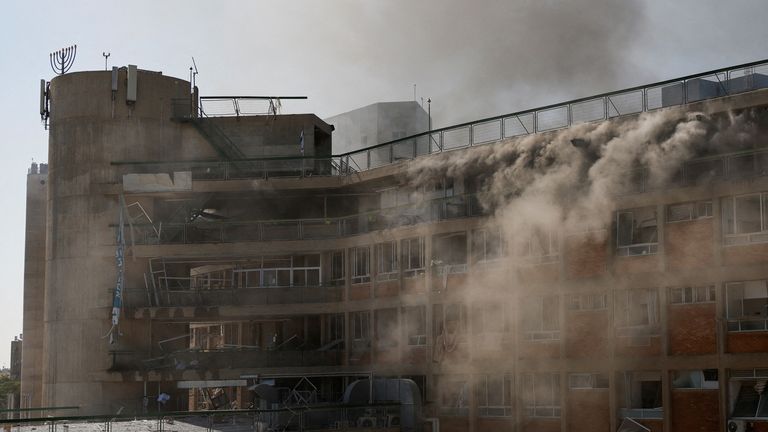
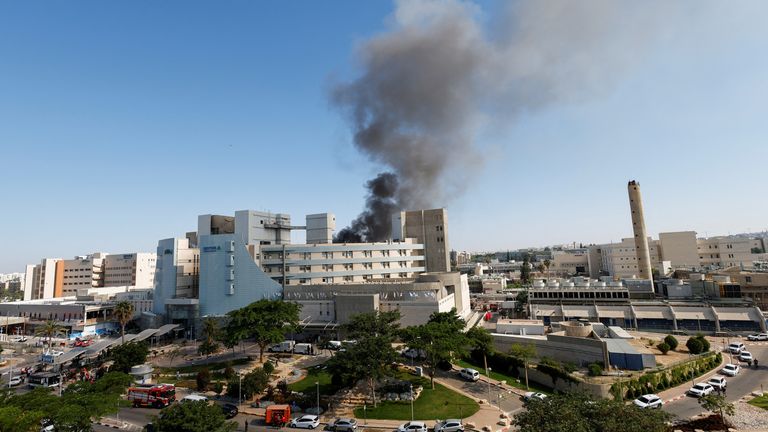
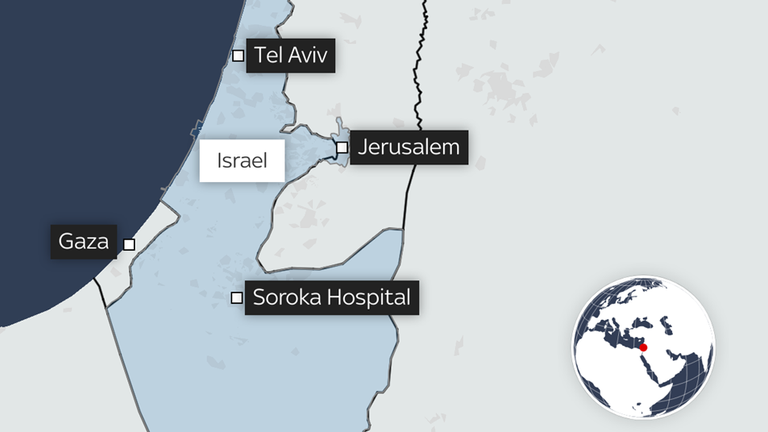
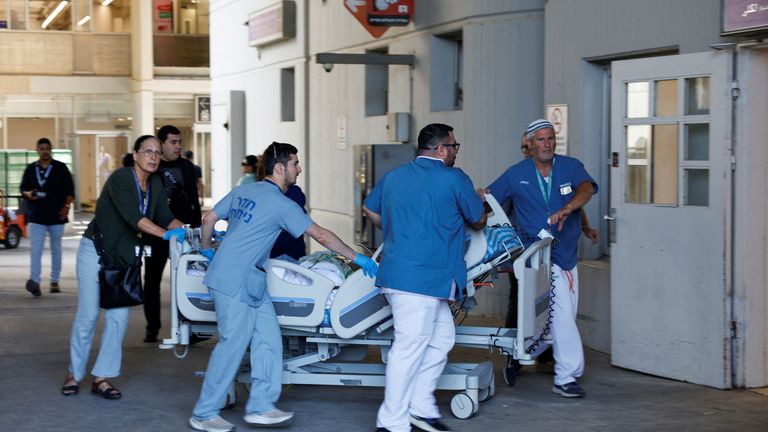
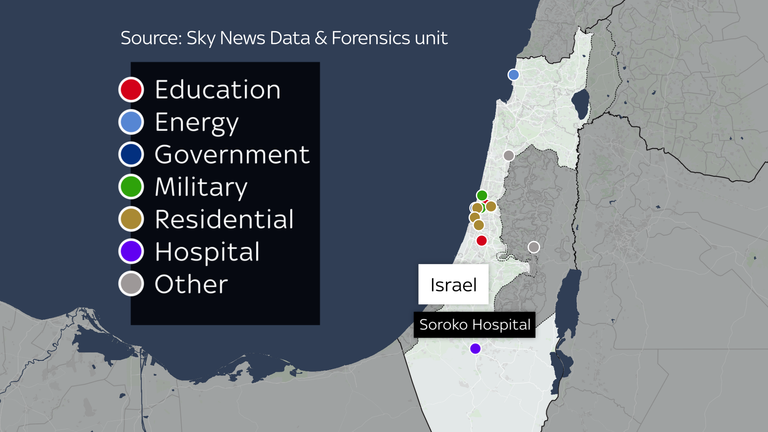
The Soroka Hospital, in Beer Sheba, suffered “extensive damage”, officials said. It is the main hospital in Israel‘s south and sustained a “direct hit” by a ballistic missile this morning, according to Israeli authorities.
Two people were seriously injured and around 40 were wounded, according to Israeli emergency services.
Iran‘s state media said its main targets were an IDF command and intelligence headquarters next to the hospital.
Image: The medical facility in Beer Sheba after the missile strike from Iran. Pic: Reuters/Amir Cohen
Image: Pic: Reuters
Image: Pic: Reuters
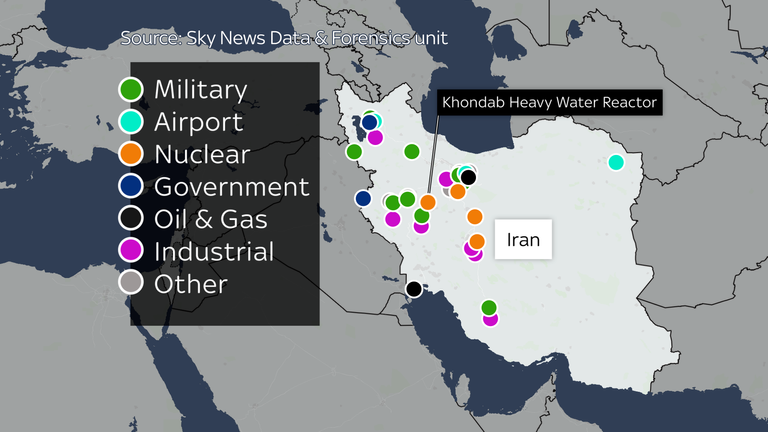
The Israel Defence Forces (IDF) attacked the Khondab nuclear site, which is roughly 250 miles (400km) west of Tehran, overnight after telling people nearby to evacuate.
Iranian media confirmed two projectiles hit an area close to the partially built heavy-water research reactor, with officials telling state media that no risks of radiation or casualties were detected.
Iran’s atomic energy organisation described the attack on the facility, originally known as Arak, as a “renewed violation of international law”.
Meanwhile, Israel’s Prime Minister Benjamin Netanyahu vowed to “exact the full price” from Iran after the hospital strike.
“This morning, Iran’s terrorist tyrants launched missiles at Soroka Hospital in Beer Sheba and at a civilian population in the centre of the country,” he wrote on X. “We will exact the full price from the tyrants in Tehran.”
Mr Netanyahu added in a later statement that he was asked whether Israel was targeting the downfall of the regime.
He said it was “up to the Iranian people to rise for their freedom”, adding: “Freedom is never cheap, it’s never free. Freedom requires the subjugated people to rise up and it’s up to them, but we may create conditions that will help them do it. “
Mr Netanyahu claimed that there is no military site for “miles and miles” around the hospital and that it would say “everything” about Israel and Iran by Tehran “targeting a hospital” and the IDF “targeting nuclear sites and missile sites”.
His defence minister Israel Katz vowed to “increase the intensity of attacks” against Iran.
“The Prime Minister and I have instructed the IDF to increase the intensity of attacks against strategic targets in Iran and against government targets in Tehran in order to remove threats to the State of Israel and undermine the ayatollahs’ regime,” he wrote on X.
Image: Strikes on Israel
Sky News correspondent Cordelia Lynch was at the Soroka Hospital following the strike and said she saw smoke rising from the building.
“We heard eyewitness accounts of people hearing a loud boom as this medical centre was struck,” she said.
“We’ve been seeing patients being wheeled out here, we’ve seen others with minor injuries, but it’s unclear when exactly they incurred those.”
Israeli air defences were penetrated over central parts of the country overnight. According to a military official, several population centres, including the hospital, were hit after dozens of missiles were launched.
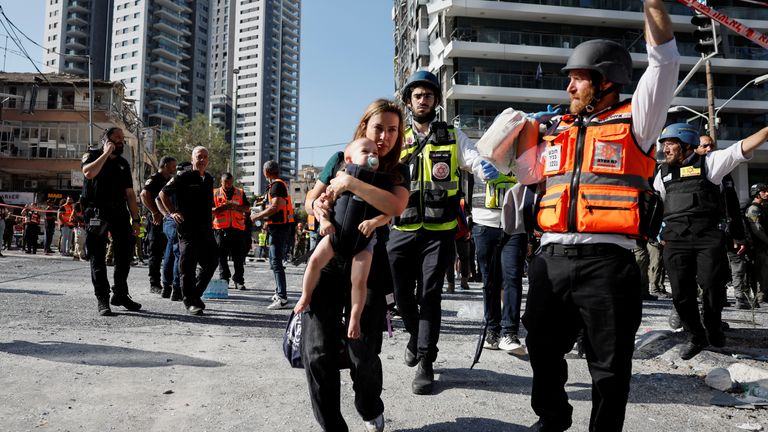
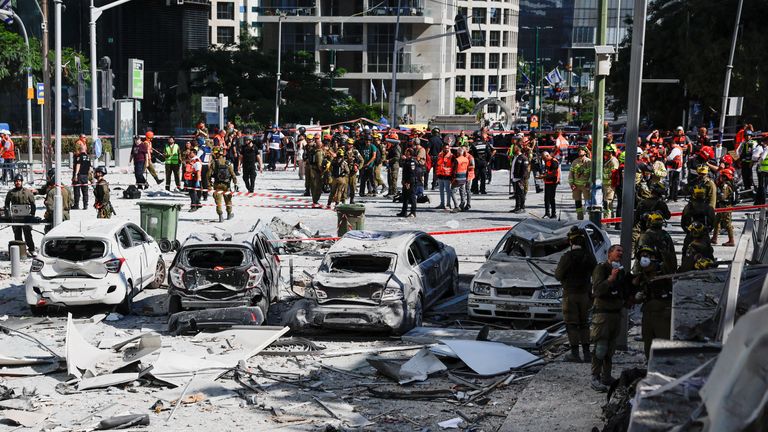
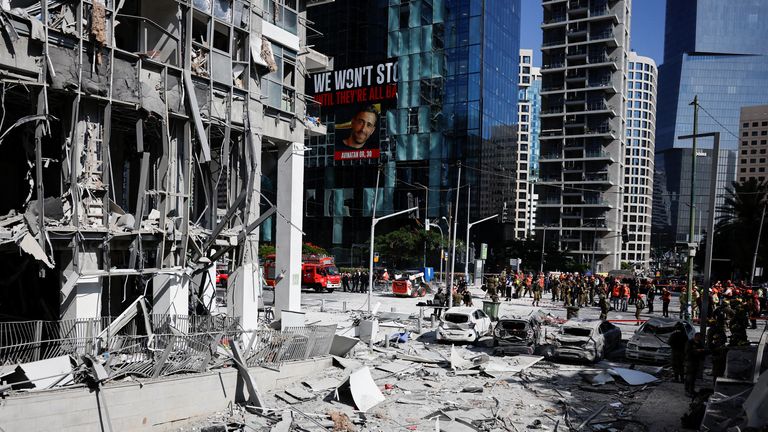
Ramat Gan, east of Tel Aviv, was one of the areas hit by Iranian attacks overnight, leading to extensive damage.
Image: People flee an Iranian missile strike in Ramat Gan, Israel. Pic: Reuters
Image: Emergency personnel at the site. Pic: Reuters/Ammar Awad
Image: Debris can be seen on the streets in the area. Pic: Reuters/Ammar Awad
Trails of missiles and interception efforts were visible in the skies over Tel Aviv this morning as explosions were heard.
The emergency services said five people had been seriously injured in the attack, with dozens of others hurt in three other locations. In south Tel Aviv, people are trapped in a building, it said.
Israel’s attack on the Khondab nuclear facility, which its military identified as a key component in plutonium production, was accompanied by strikes on what Israel said were nuclear weapons development sites in Natanz and Isfahan.
Construction at the Khondab nuclear site was halted, while its core was removed and filled with concrete to make it unusable under a 2015 nuclear deal between Iran and world powers. But Iran told the UN’s nuclear watchdog that it planned to start operating the reactor in 2026.
Heavy-water reactors pose a nuclear proliferation risk because they can easily produce plutonium which, like enriched uranium, can be used to make the core of a bomb.
Image: Strikes on Iran
The Khondab reactor was “not operational” when it was struck by Israel, the International Atomic Energy Agency (IAEA) said.
The nuclear watchdog said the facility was under construction at the time Israel struck it.
“It was not operational and contained no nuclear material, so no radiological effects,” it added in a post on X.
Natanz was the site of a complex at the heart of Iran’s nuclear programme that included two enrichment plants.
The site was previously struck by Israel during its aerial war with Iran, which started a week ago.
Real Madrid striker Kylian Mbappe has been taken to hospital with gastroenteritis after missing his side's 1-1 draw with Al-Hilal at the Club World Cup on Wednesday evening.The France international was absent as Los Blancos' hopes of glory got off to a stuttering start in Miami.Real went ahead through Goncalo Garcia, only for former Wolves star Ruben Neves to level for the Saudi Pro League side from the penalty spot.Xabi […]









Post comments (0)