The BBC has said it breached its editorial guidelines by failing to disclose that the child narrator of a Gaza documentary was the son of a Hamas official.
A report into the controversial programme said three members of the independent production company knew about the role of the boy’s father – but no one within the BBC was aware.
The review called the failure to bring the information to the BBC’s attention a “significant oversight by the production company”.
The independent report – commissioned by the corporation – criticised the BBC team involved in the documentary for not being “sufficiently proactive” with initial editorial checks, and for a “lack of critical oversight of unanswered or partially answered questions” ahead of broadcast.
It described the background on the narrator’s father as “critical information”, which was not shared with the BBC before broadcast.
While the report said there was no evidence “to support the suggestion that the narrator’s father or family influenced the content of the programme in any way”, it concluded the use of a child narrator for the programme was “not appropriate”.
Following the release of the report, media watchdog Ofcom said they would be launching their own investigation, under their rule which states that factual programmes must not materially mislead the audience.
Gaza: How To Survive A Warzone aired on the BBC in February, but was pulled from iPlayer after it emerged that the child narrator was the son of Ayman Alyazouri, who has worked as Hamas’s deputy minister of agriculture.
How To Survive A Warzone was made by independent production company Hoyo Films, and features 13-year-old Abdullah al Yazouri, who speaks about life in Gaza during the war between Israel and Hamas.
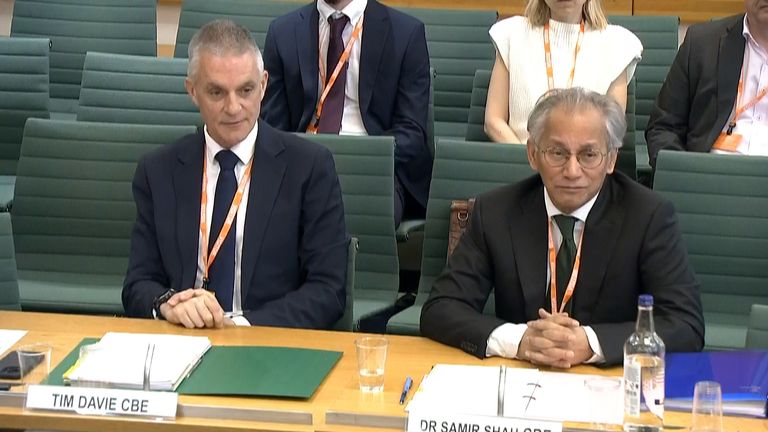
Image: (L-R) Tim Davie and BBC chairman Samir Shah answering questions at the Culture, Media and Sport Committee earlier this year. Pic: PA
The review was led by Peter Johnston, the BBC‘s director of editorial complaints and reviews, who reports directly to director general Tim Davie.
It found that a fee of £795 was paid for the narrator, paid to his sister. The report found that was not “outside the range of what might be reasonable in the context”.
The report did not name any individuals facing disciplinary action, but a new leadership role has been created in BBC News documentaries and current affairs, which the corporation says will be advertised in the next seven days.
While the BBC said the report found Hoyo Films did not “intentionally” mislead the BBC, the corporation said the independent production company “bears most responsibility for this failure”.
The broadcaster added that it also “bears some responsibility”.
On the face of it, the behaviour of MasterChef presenter Gregg Wallace and a documentary about Gaza criticised for featuring the son of a Hamas minister seem like two totally separate issues.
But it’s not just the timing of the reports – with both arriving today – that links them.
Both point to failings of management and a lack of due diligence at the BBC.
The Silkin report, commissioned by production company Banijay, found more than half of the 83 allegations against Wallace have been substantiated, including one of “unwanted physical contact”.
It found that in terms of the BBC, there was “no consolidated or central record of issues or concerns which had arisen in relation to Mr Wallace”.
While the report on Gaza: How to Survive a War Zone found the BBC had breached one of its own editorial guidelines by not disclosing that the documentary’s child narrator was related to a Hamas minister – with director general Tim Davie apologising for “a significant failing in relation to accuracy”.
While Wallace has been sacked from the BBC, no one has lost their job following the Gaza documentary controversy – instead the organisation is hiring a new role to help with the long-form work going forward.
But is it enough?
Today’s reports are the latest updates in a series of scandals for the broadcaster, and with the government looking at overhauling the corporation’s current funding model, the future of the BBC has never looked more uncertain.
Culture secretary ‘pleased’ that ‘catastrophic’ failures acknowledged
Flagging “a significant failing” in the documentary, Mr Davie said: “I am sorry for this failing.”
He said action would now be taken to ensure “proper accountability” and also “prevent such errors being repeated”.
The BBC Board said: “Nothing is more important than trust and transparency in our journalism. We welcome the actions the Executive are taking to avoid this failing being repeated in the future.”
Culture Secretary Lisa Nandy said she was “pleased” that the BBC has acknowledged “catastrophic” failures.
She said she had had “several meetings” with the corporation, adding: “I believe that they are acting now at pace to put in place measures to make sure that this cannot happen again.”
Children ‘deserve to have their voices heard,’ Hoyo Films says
Hoyo Films said it takes the report findings “extremely seriously,” and also apologised.
The company said it was “working closely with the BBC” to see if it could find a way to bring back parts of the documentary to iPlayer, adding: “Our team in Gaza risked their lives to document the devastating impact of war on children.
“Gaza: How To Survive A Warzone remains a vital account, and our contributors – who have no say in the conflict – deserve to have their voices heard.”
The BBC says it has no current or future planned commissions with Hoyo Films.
Following the release of the report, Israel’s UK embassy questioned the finding that there had been “no breach of impartiality” in the documentary, and asked whether money paid to the boy could have ended up in the hands of Hamas.
Speaking to the Culture, Media and Sport Committee earlier this year, Mr Davie described the fallout over the documentary as “damaging,” and said the corporation was “not told” about questions asked around Abdullah’s father.
Ofcom previously warned that recent controversies could “start to erode public trust and confidence”.
Israel does not allow international news organisations into Gaza to report independently.
England secured a thrilling 2-1 series lead over India after Shoaib Bashir claimed the final wicket in extraordinary circumstances to end five days of captivating Test cricket.The young spinner delivered the decisive blow when Mohammed Siraj defended solidly into the ground, only for the ball to trickle around his legs and onto the stumps.The dramatic conclusion came with India fighting valiantly to save the match, having been reduced to 82 […]









Post comments (0)