This is a rush transcript. Copy may not be in its final form.
AMY GOODMAN: I also wanted to ask Miriam Pensack about Guantánamo, the Pentagon saying some 300 additional soldiers have arrived at the U.S. naval base at Guantánamo Bay, Cuba, have begun constructing a tent city to detain up to 30,000 immigrants and asylum seekers. On Monday, the Cuban President Miguel Díaz-Canel condemned the Trump administration’s attack on asylum seekers. This is what he said.
PRESIDENT MIGUEL DÍAZ-CANEL: [translated] For Cuba, the violent and indiscriminate deportation of immigrants by the United States, arbitrary detentions and other human rights violations are unacceptable. These measures are also used as a political pressure and blackmail weapon against the peoples of our America. The establishment of a detention center at the American naval base in Guantánamo, where it is intended to imprison tens of thousands of people, constitutes a barbaric act.
AMY GOODMAN: So, that’s the president of Cuba. Miriam Pensack, your forthcoming book is on Guantánamo. Can you give us the history of how the U.S. has used it?
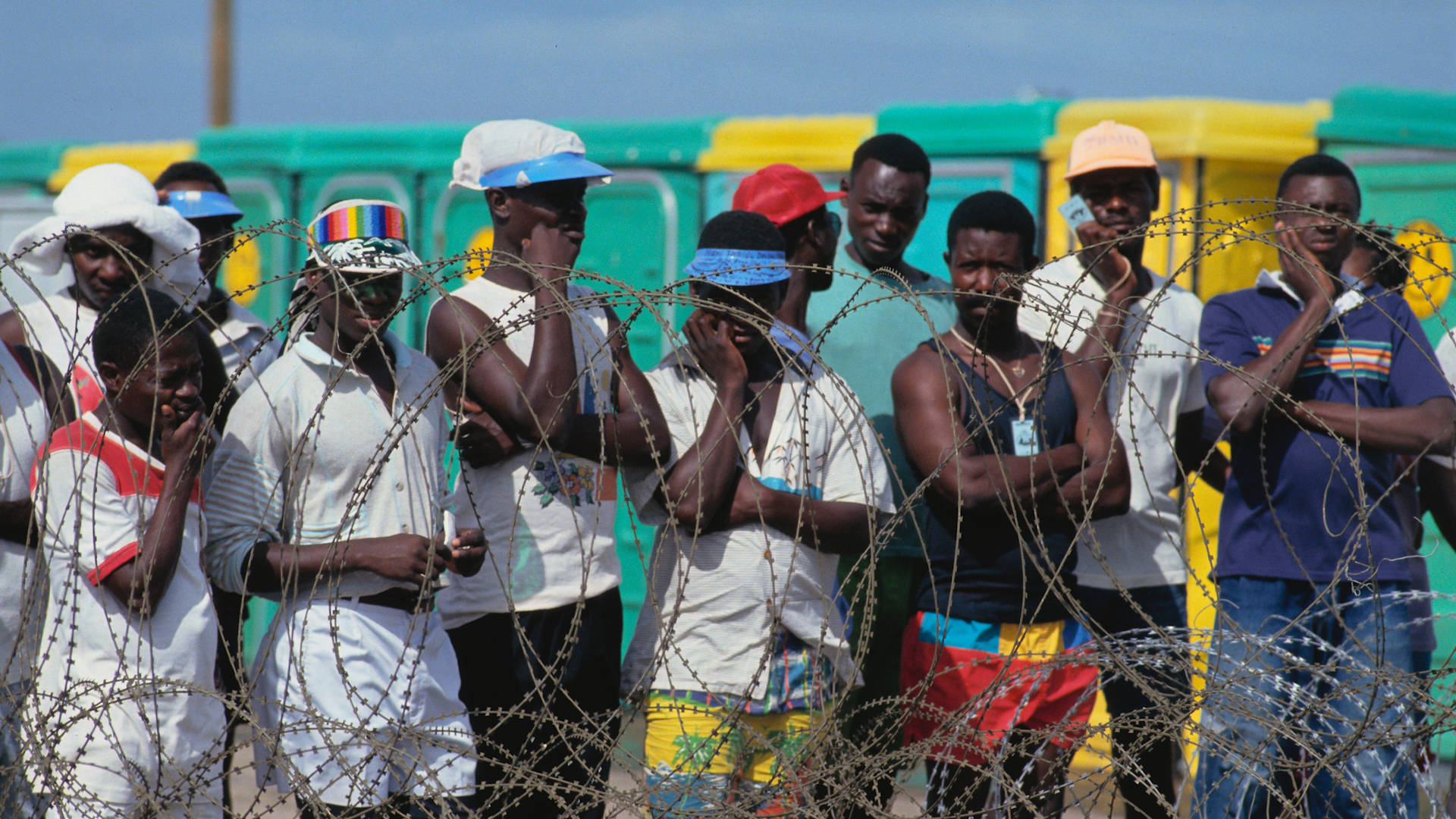
MIRIAM PENSACK: Sure. So, something that I should mention first and foremost is that before Guantánamo became what it was known for in early 21st century, the sort of “forever prison in the war on terror,” the way that its ambiguous sovereignty, as a U.S. base coercively held on Cuban soil, functioned was to hold tens of thousands of circum-Caribbean asylum seekers, first from Haiti, roughly 40,000 from Haiti, then 35,000 Cubans who fled the island during what was called the Special Period, so the collapse of the Soviet Union, which prompted the total collapse of Cuba’s economy in the mid-’90s. So, this is actually a sort of back to basics, unfortunately, for Guantánamo.
And those initiatives, first the Haitian internment and then the Balsero crisis of Cuban rafters a few years later, what happened with the Haitians, they were, by and large, repatriated to extremely dangerous conditions in Haiti, where a coup had taken place against Haiti’s first democratically elected president, Jean-Bertrand Aristide. And Cubans eventually made it to the United States, but not after — you know, after effectively being held in what were concentration camp-, detention camp-like conditions in Guantánamo. And they were allowed into the United States because — in part because of the establishment of what became known as wet foot, dry foot.
JUAN GONZÁLEZ: Yeah, I also wanted to ask you about the Dominican Republic, where Rubio will also be visiting. The Dominican Republic has for years been involved in its own migration crackdown against Haitians within the country, massive attempts to deport Haitians from the DR. What do you sense might come out of Rubio’s visit there?
MIRIAM PENSACK: I think there will definitely be a willingness to collaborate on immigration and deportation. You know, the Dominican Republic has been building a wall between itself and Haiti, which it shares the island of Hispaniola with. You know, there have been these mass attempts to deport Haitians. There have also been efforts to strip Dominican citizens of their citizenship if they have what has been in many cases very flimsy proof of Haitian origin or provenance. You know, so it’s very anti-Black, because Haiti was the first Black republic, and Haitians are — there are plenty of Black Dominicans, I should say, but there is a huge degree of anti-Blackness involved in that. And the Dominican Republic has, in fact, left some of its citizens who it deemed Haitian stateless, because Haiti did not recognize them as Haitian citizens.
AMY GOODMAN: Miriam Pensack, we want to thank you so much for being with us, historian of modern Latin America, postdoc fellow at Princeton University, writing a book on Guantánamo. Roman Gressier is a French American journalist based in Guatemala City, where he’s the editor of El Faro English, host of the podcast Central America in Minutes. And Miriam was speaking to us from Panama City, where Secretary of State Rubio just was.
Coming up, President Trump is threatening to deport pro-Palestinian student protesters. In a recent executive order, he urges schools to, quote, “monitor and report activities by alien students.” We’ll speak with a student who was threatened with deportation at Cornell University and with an Israeli reporter, a conscientious objector, who just wrote a piece for Haaretz on deporting those who support justice in Palestine. Stay with us.








Post comments (0)