A coroner has recorded an open conclusion into the death of TV doctor Michael Mosley, who died after going for a walk on a Greek island.
The 67-year-old’s body was found days after a search was launched by emergency services on Symi.
Crispin Butler, the senior coroner for Buckinghamshire, said the broadcaster’s death was “indeterminate” and “unascertainable”.
He added it was “most likely attributable either to heatstroke [accidental] or non-identified pathological cause”.
Mr Butler said: “Michael Mosley collapsed and died on the 5th of June 2024 in a rocky area near Agia Marina Beach, Symi, Dodecanese, Greece.
“There had been high temperatures during this time.”
He said: “Michael’s death was most likely attributable either to heatstroke [accidental] or a non-identified pathological cause. There was nothing of note in toxicology.
“No medical cause of death could be ascertained, meaning Michael’s death may have been due to a medical event or as a result of a non-traumatic accident.”
Mosley and his wife had travelled to Symi with another couple for a week’s holiday.
During the trip they took a boat and went for a swim at Saint Nikolas Beach on 5 June – however, Mosley chose to return from the beach on foot and was later reported missing by his wife Claire.
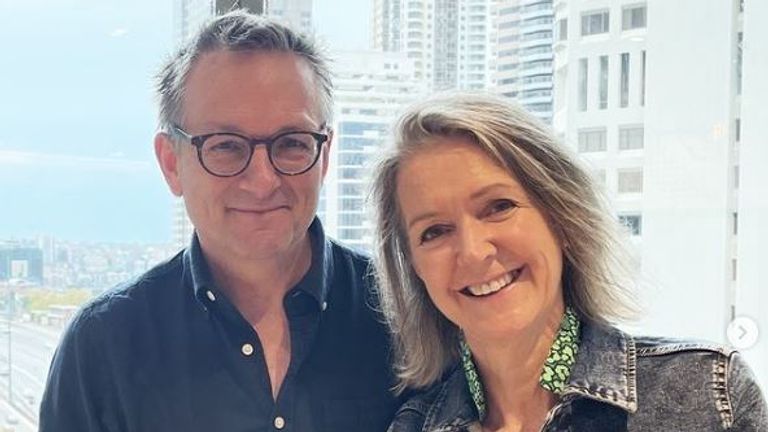
Image: The TV doctor and his wife Dr Clare Bailey Mosley. Pic: Instagram
His body was found four days later in rocky terrain following an extensive search effort in sweltering temperatures.
CCTV footage appeared to show him falling over close to where his body was found and no one else was with him. He was just metres from safety.
In written findings, Mr Butler said Mosley’s death was not found to be as a result of homicide, suicide, or an accident related to injuries.
“Michael was described as looking energetic and cheerful as he set off,” he said.
He added: “Ultimately Michael’s death was classified as indeterminate, which we would describe as ‘unascertainable’.”
Mosley first trained as a doctor before moving into the world of broadcasting, presenting a host of science programmes and films on the BBC including the series Trust Me, I’m A Doctor, which looked at healthcare in Britain.
He was best known for popularising the 5:2 diet, a form of intermittent fasting, as well as his documentaries and the Just One Thing health podcast.
In 2002, he was nominated for an Emmy for his executive producer role on BBC science documentary The Human Face, and he also ingested tapeworms for six weeks for a 2014 documentary called Infested! Living With Parasites.
A "blob-headed" fish and a semi-aquatic mouse are among 27 newly discovered species found in a remote region of the Amazon rainforest in Peru.Scientists also encountered a new species of dwarf squirrel, salamander and short-tailed fruit bat during their expedition to the remote forest of Alto Mayo, according to the findings published by Conservation International. The protected area in northern Peru is home to several ecosystems, indigenous territories and villages.Among […]







Post comments (0)